October 02, 2026
Carrots have a reputation for being fussy. In open ground they fork at the first stone, split after a dry spell and seem to attract carrot root fly from a county away. In a container, most of that trouble disappears. You choose the compost, so there are no stones and no hard pan for the roots to hit. You control the water. And a pot raised on a bench, a wall or a balcony rail sits well above the flight path of the carrot fly, which is a low, weak flier. Get the variety and the watering right and even a modest pot will give you some of the sweetest carrots you have grown.
Pick a variety that fits the pot
The most common mistake is sowing a long maincrop carrot in a shallow container and hoping. Carrot roots grow straight down and they do not bend politely at the base of the pot. Match the variety to the depth you can offer.
- Round types – 'Paris Market' and 'Parmex' need only 12–15cm of compost. They are the answer for windowsills, small troughs and anyone short of space.
- Short conical types – 'Chantenay Red Cored' is the classic, stout and sweet, happy in 20–25cm.
- Slender cylindrical types – 'Amsterdam Forcing', 'Nantes 2' and 'Early Nantes' want 25–30cm. They crop quickly and are excellent for pulling young as baby roots.
'Flyaway' has some tolerance of carrot root fly and is worth a try if the pest has beaten you before. Maincrop varieties such as 'Autumn King' are superb carrots, but they want deep containers and a long season, so treat them as a project rather than a first attempt.
Depth, width and drainage
As a rule, give the compost at least 5cm more depth than the carrot is long. A 30cm pot is comfortable for Nantes types; a shallow 15cm trough is perfect for round ones. Width matters more than height for a small crop: a wide pot holds more roots per watering and dries out less quickly than a tall, narrow one.
Drainage holes are not optional. Cover them with a small piece of mesh or a single crock to stop compost washing out, then stand the pot on feet or bricks so water can escape freely. Carrots left sitting in a saucer of water rot at the crown, and the smell of rotting roots is exactly what brings in trouble.
Mixing the right compost
Use fresh, peat-free multipurpose compost, and sieve out any lumps of bark or unrotted material that could deflect a young root. Then lighten it with grit: roughly three parts compost to one part horticultural grit or sharp sand. This improves drainage and gives the roots an easier run.
What you must not do is feed the compost heavily. Rich soil, especially anything with fresh manure, produces fluffy tops and forked, hairy roots. Sprinkle a general-purpose fertiliser at about half the recommended rate, or mix in a little slow-release feed, and leave it at that. Fill the pot to about 2cm below the rim, firm it gently, water well and let it settle overnight before sowing.
Sowing thinly, thinning bravely
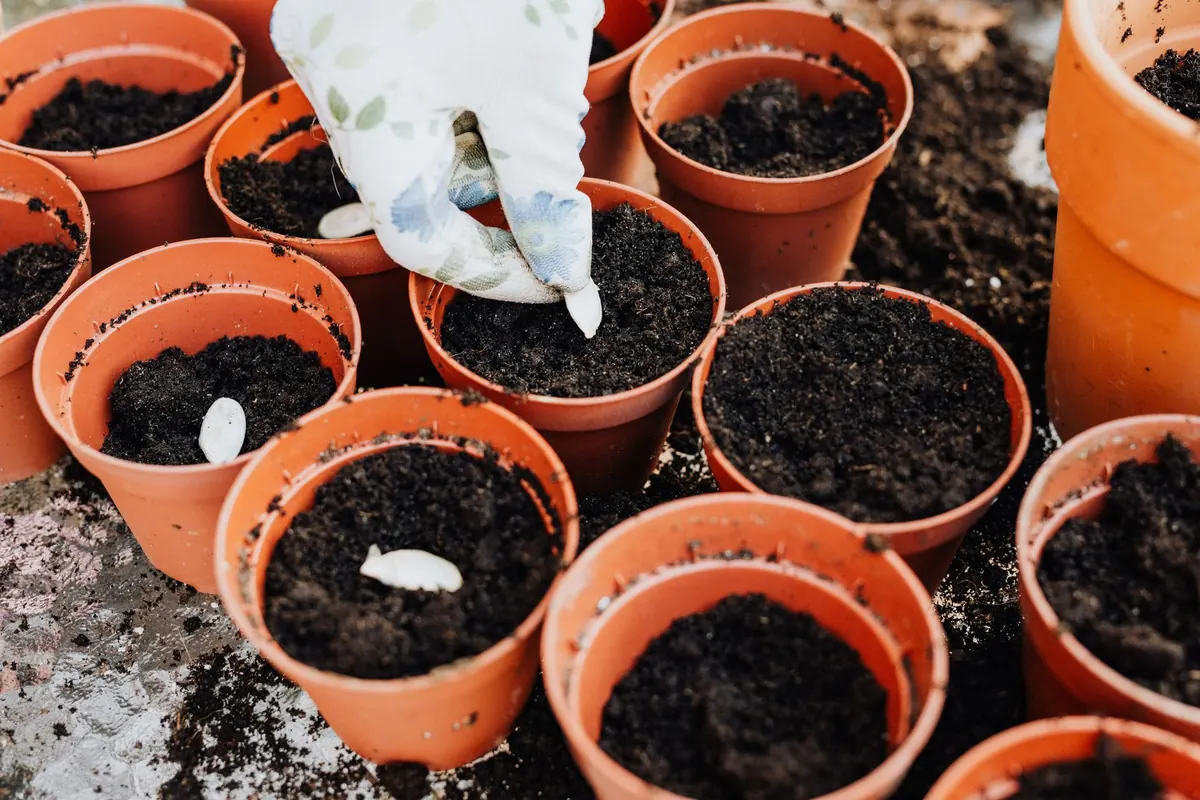
Carrots hate being moved, so sow them where they are to grow. Make shallow drills about 1cm deep, 5–7cm apart, and sow sparsely. Germination takes roughly ten days to three weeks depending on temperature, and the surface must not dry out in that time. A sheet of cardboard or fleece laid over the pot until the seedlings appear makes a real difference.
Thinning is the job most growers skip, and it is the reason they end up with a tangle of thin, bitter roots. When the seedlings are 2–3cm tall, thin them to about 4cm apart for baby carrots and 6–7cm for larger roots. Do it in the evening, and snip the unwanted seedlings at soil level with scissors rather than pulling them. Pulling disturbs the roots you are keeping and releases the carrot scent that draws in carrot fly.
For a steady supply, sow a small pot every three weeks from March to July. A late-July sowing will stand in the ground through autumn and give you fresh roots well into winter.
The watering routine that makes roots sweet
Consistency matters more than quantity. A daily dribble encourages shallow roots; a long drought followed by a soaking splits them. Aim to keep the compost evenly moist, and check by pushing a finger 2cm below the surface rather than trusting the look of the top.
While the seedlings establish
Water gently, at the base, in the mornings, so the surface never dries out completely. A fine rose on the watering can avoids washing seeds into a heap at one end of the pot.
Once the roots are swelling
Switch to a thorough soak two or three times a week, until water runs from the base. In hot, breezy weather a container may need water daily, sometimes twice. Terracotta pots lose moisture quickly; plastic and glazed pots hold it better. A thin mulch of compost over the surface slows evaporation and keeps the shoulders of the roots covered, which stops them turning green.
Feeding, pests and carrot fly
Carrots in containers need very little feeding. A weak liquid seaweed or tomato feed every three or four weeks is plenty; more than that and you grow leaves, not roots.
Carrot fly is the one pest worth planning for. Adults fly low and are drawn by the smell of crushed carrot foliage, so a fine mesh or fleece barrier around 60cm tall, put in place before sowing and left until harvest, is the most reliable defence. Pots on an exposed, windy balcony are also less likely to be found. Planting chives, spring onions or rosemary nearby is a pleasant companion tradition rather than a guarantee.
Slugs and snails graze young seedlings, so check the pot after dark with a torch during the first few weeks. Aphids can be washed off with a jet of water. If plants suddenly wilt and yellow, lift one and look at the roots: root aphids mean the crop should be binned and the compost not reused for carrots.
Harvesting and storing
Baby carrots are ready in about ten to twelve weeks; larger short types take twelve to sixteen. Brush the compost away from the shoulder of one root to judge the size. Once the top of the carrot is roughly 2cm across, it is ready. Water the pot an hour before lifting, then twist and pull from the base of the foliage. Round types are best lifted when they reach golf-ball size.
Leave the rest in the compost and pull them as you need them — they keep surprisingly well in cool weather. If you must lift a batch, twist off the foliage and store the roots in a bag in the fridge for a week or two.
A simple plan for the season
- Sow a short-rooted variety in a 25–30cm pot of gritty, lightly fed compost.
- Cover the pot with fleece or fine mesh before the seedlings appear, and keep it there.
- Thin to 4–7cm in the evening, using scissors.
- Water thoroughly two or three times a week rather than little and often.
- Sow a fresh small pot every three weeks for a continuous crop.
- Harvest young, pull what you need, and start again.
Start with one pot of 'Paris Market' and one of 'Nantes 2'. The first is quick, forgiving and almost comically productive for its size; the second will teach you what a proper baby carrot tastes like when it has never spent a day in a supermarket bag. Keep the compost damp, keep the fleece on, and the only real difficulty will be stopping at two pots.
Photo: kevin1469 / Pixabay